
Commercial Cooling Built Around the Building's Actual Load
Commercial AC Installation and Repair in Austin for offices, restaurants, warehouses, and retail spaces with systems that no longer match the building's layout or tenant use
A rooftop package unit or split system sized for one tenant rarely performs correctly for the next one, and Austin's commercial stock ranges from older strip-center retail built decades ago to newer light-industrial and office buildings—each with different layout constraints and occupancy profiles. Extreme Texas Air installs and repairs commercial air conditioning for businesses across this range, working from a site survey and load calculation rather than defaulting to whatever size was there before. The company is a family-owned HVAC contractor licensed under TACLA 67449C that has served commercial clients since 2014, with the owner bringing over 20 years of industry experience to every project.
For repairs, a technician inspects the existing unit and controls, checks airflow, refrigerant charge, and electrical connections, and reports findings before any work begins. That sequence means the business understands what the actual problem is before approving a repair, and it avoids replacing components that are functioning correctly. For installations, the process begins with a load calculation that accounts for the building's current use—occupancy, equipment heat load, and ductwork condition—before any equipment is selected or quoted.
Arrange an on-site assessment of your current commercial AC system by calling Extreme Texas Air to describe the problem or the installation you need.
What Commercial AC Installation and Repair Actually Accomplishes
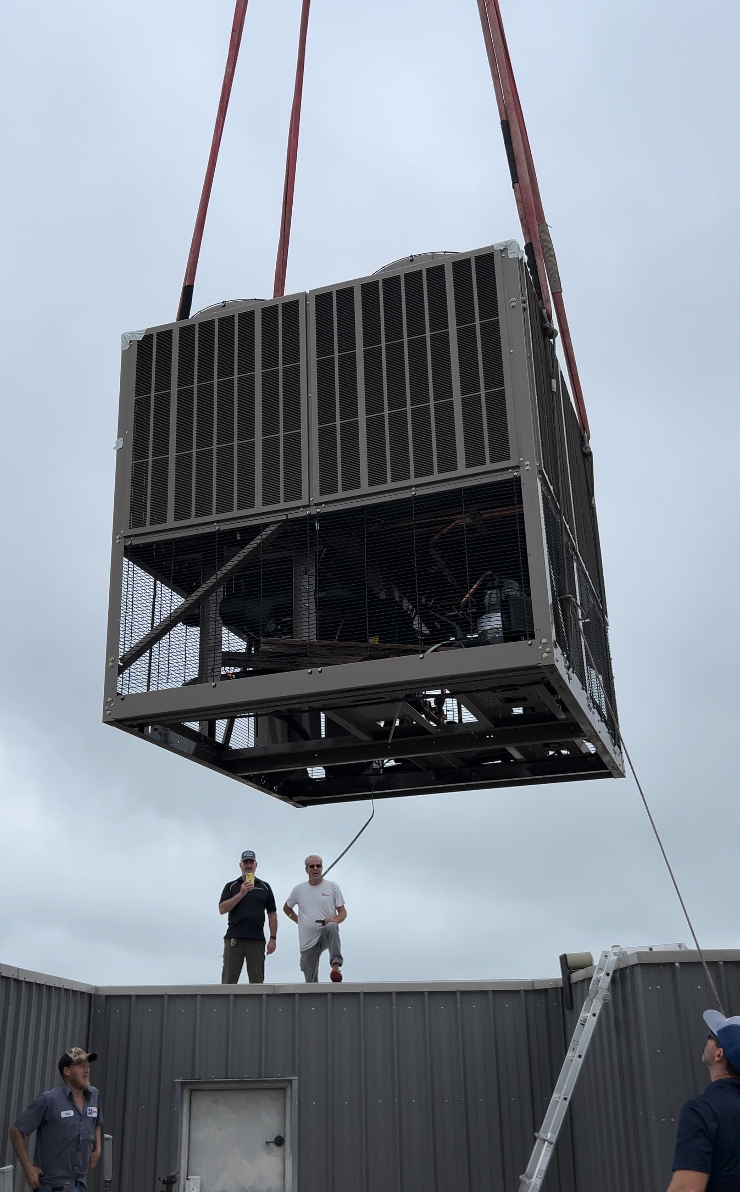
The difference between a correctly sized installation and a matched-to-the-old-unit swap shows up within the first week of operation. A system sized to actual load maintains setpoint without extended run cycles, removes humidity at the rate the space produces it, and stages properly if the building has a multi-zone layout. In older Downtown Austin and Round Rock commercial buildings where ductwork has been modified across multiple tenancies, the installation also involves evaluating whether existing trunk lines and diffuser placement are compatible with the new equipment's airflow design.
After a repair, the specific change depends on what was found: a low refrigerant charge correction restores the system's ability to hold setpoint and prevents evaporator coil freeze-ups; an electrical connection repair eliminates intermittent shutdowns that look like a failing compressor; a control board or contactor replacement allows the unit to stage correctly instead of short-cycling. Each of those outcomes is observable on the thermostat and in the occupied space within a normal operating cycle.
Extreme Texas Air provides quotes for new equipment on request and does not push replacement when a repair will restore normal operation. The decision between repair and replacement is presented with the diagnosis, not before it, so the business makes that call based on the actual condition of the system.
Common Questions About This Service
Commercial AC installations and repairs involve decisions that vary by building type, system age, and how the space is currently used. The questions below address the process steps and what drives the choices made during each.
What happens during the site survey before a commercial AC installation?
The technician measures the conditioned space, identifies existing ductwork layout, checks electrical service capacity at the disconnect, and evaluates rooftop or ground-level clearances to determine what equipment can be physically set and connected.
How does a technician determine whether a refrigerant charge issue is a leak or just a low charge?
Refrigerant charge is measured with gauges against the manufacturer's specification; if the system is short and there is no visible oil staining or ice pattern that would indicate a leak location, a dye test or electronic leak detector is used before refrigerant is added.
Why does airflow need to be checked as part of a commercial AC repair diagnosis?
A refrigerant or electrical problem and an airflow restriction produce similar symptoms—the system runs long cycles and fails to reach setpoint—but the repair approach is entirely different, so airflow is confirmed before refrigerant charge or electrical components are evaluated.
What does startup testing cover after a new commercial AC unit is installed?
The technician measures supply air temperature differential across the evaporator, checks static pressure at the air handler, confirms that all thermostats and zone controls are staging the equipment correctly, and verifies that condensate is draining properly from the new unit's pan.
How does the age and construction of a commercial building affect which AC equipment can be installed?
Older commercial buildings in Austin often have undersized electrical service or duct systems with trunk sizes designed for lower-efficiency equipment, which limits the replacement options to units with compatible static pressure ratings or requires duct modifications before a higher-efficiency system can be installed.
Extreme Texas Air also installs and repairs commercial AC in Kyle, Buda, San Marcos, Dripping Springs, and Lockhart. To start with a technician assessment of your system, call (512) 256-5499 and describe the symptoms or the installation scope.