
Heat That Reaches Occupants, Not Just the Ceiling
Commercial Heating Installation and Repair in Austin for large open floor plans where heat distribution fails to reach occupied zones
Gas furnaces and heat-pump systems installed in large commercial floor plans collect heat near the ceiling rather than at occupant level when distribution is not matched to the space. Many commercial buildings in the Austin area run exactly this configuration—open offices, warehouse bays, and restaurant dining rooms where the heater is operational but the occupied zone stays cold. Extreme Texas Air provides commercial heating installation and repair for businesses in these conditions, working from a diagnosis first so the repair addresses what is actually failing rather than what is easiest to replace. The company is licensed under TACLA 67449C, has operated since 2014, and the owner brings over 20 years of industry experience to every service call.
Repair work begins with a check of the burners or heat source, ignition sequence, safety controls, thermostat, blower operation, and the ductwork delivering heat to the occupied portions of the space. Each of those components is tested before parts are ordered, and the repair is quoted and explained after diagnosis. For installations, the process includes a heat load calculation, equipment selection, gas or electrical connection, and a commissioning test that confirms output and control staging—not just that the unit powers on.
Call Extreme Texas Air at (512) 256-5499 to arrange a diagnostic visit for your commercial heating system or to discuss a heating installation for a new or re-tenanted space.
Why Diagnosis Drives Every Heating Repair Decision
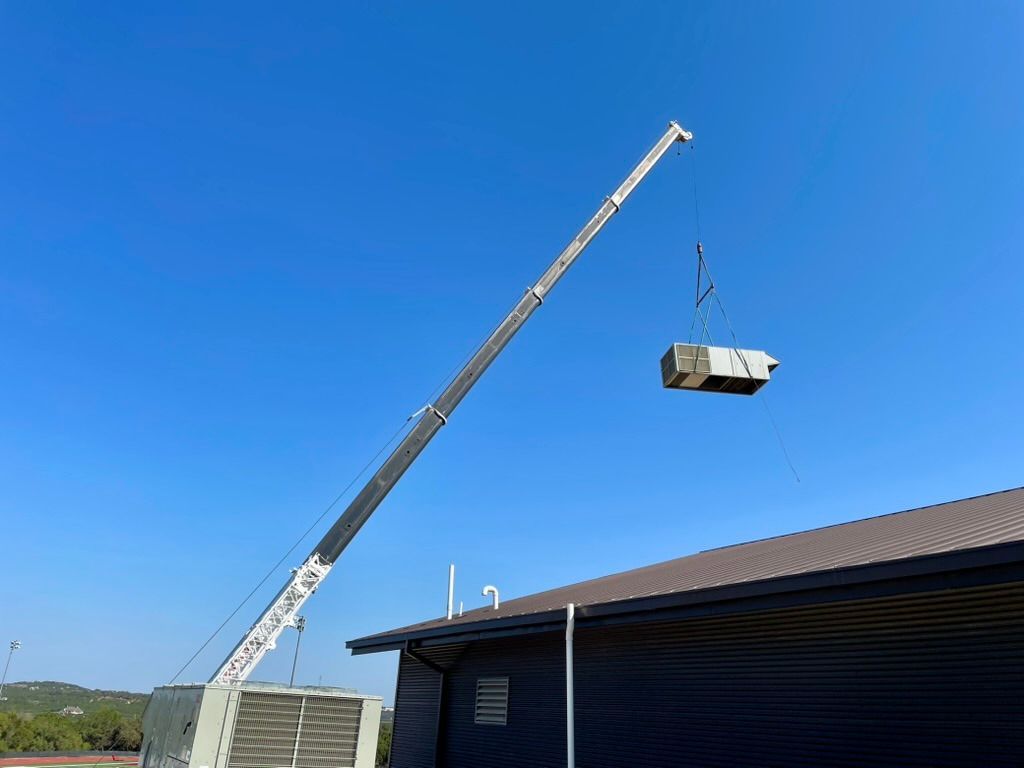
Commercial heating failures rarely announce themselves with a single clear symptom. A burner that ignites intermittently may point to a failing igniter, a dirty flame sensor, or a gas pressure issue—three different repairs with different parts and labor sequences. In Cedar Park and Pflugerville commercial buildings where gas-fired rooftop units serve multi-suite office or retail space, a misdiagnosed repair can leave the underlying problem active while the business pays for a part that was functioning correctly. Extreme Texas Air works through the full sequence of ignition, combustion, and distribution before recommending any part replacement.
After a successful heating repair, the specific change the building occupants notice depends on what was corrected. A blower motor repair restores airflow volume so heat actually circulates from the diffusers rather than stratifying near the ceiling; a thermostat or control board fix allows the system to stage and shut off at setpoint instead of running continuously or failing to start. An installation that included a correct load calculation produces consistent temperatures across the occupied zone rather than hotspots near supply diffusers and cold areas at the perimeter.
Distribution problems are sometimes misread as equipment failures because the heater appears to be running. Extreme Texas Air's diagnostic process checks duct delivery separately from heat source output, which is how a distribution issue gets separated from a mechanical one—and why the right repair is identified before any work is authorized.
Questions Before Starting Your Project
Commercial heating installations and repairs involve sequenced decisions that depend on building type, fuel source, and how the space is used. The answers below describe what that process looks like from first contact through commissioning.
What does the heat load calculation include for a commercial installation?
The calculation accounts for the building's conditioned square footage, ceiling height, insulation values, number of occupants, equipment heat loads, and whether the space has multiple zones requiring separate staging—all of which determine what output capacity the system needs to maintain setpoint under full occupancy.
How does a technician test ignition and safety controls during a heating diagnostic?
The technician cycles the system through a call for heat and monitors the igniter warm-up time, flame sensor signal, and whether the burner stays lit through a full cycle; safety limit switches are also checked to confirm they are not nuisance-tripping and shutting the system down prematurely.
Why does blower speed matter in a commercial heating system serving a large open floor plan?
A blower set below the system's designed airflow rate reduces throw distance from diffusers, which means heated air rises and stratifies near the ceiling rather than mixing down to occupant level—a distribution problem that no amount of additional heat output will correct.
What does commissioning confirm that a basic startup check does not?
Commissioning measures actual supply air temperature differential, checks gas pressure at the manifold against manufacturer specification, verifies that all thermostat stages are calling and responding correctly, and confirms that the heat exchanger is not showing combustion gases in the supply air stream.
When does a commercial heating repair require a permit in Austin?
Gas-line connections, new equipment installations, and heat exchanger replacements on commercial systems typically require a mechanical permit and inspection through the City of Austin's Development Services Department; diagnostic repairs and component replacements on existing equipment generally do not.
Extreme Texas Air also handles commercial heating installation and repair in Kyle, Buda, San Marcos, Dripping Springs, and Lockhart. To schedule a diagnostic visit or discuss a new installation, call (512) 256-5499 with your system type and a description of what the building is experiencing.