
Old Equipment Failing Your Building's Current Use
Commercial HVAC Replacement in Austin for systems undersized, outdated, or no longer matched to how your space operates
Many commercial buildings in the Austin area were constructed with HVAC equipment sized for a tenant or floor plan that no longer exists. Extreme Texas Air handles commercial HVAC replacement for businesses operating in these conditions, removing failed or mismatched systems and installing equipment calibrated to actual current load. The crew works across office buildings, retail centers, restaurants, and light-industrial spaces where the original equipment simply cannot keep up with how the building is used today.
Replacement starts with a load assessment of the building as it stands now, not as it was configured when the original system was installed. The team evaluates square footage, occupancy patterns, ductwork condition, and the efficiency tier that fits the building's operating hours before recommending equipment size. That assessment drives a written quote provided on request, and the changeout schedule is planned to reduce downtime during business hours. Once the old unit is removed, the new system is set, connected, and performance-verified before the job closes.
Request a written quote for your replacement project by calling Extreme Texas Air and describing your current system and how the building is used.
What Proper Commercial HVAC Replacement Requires
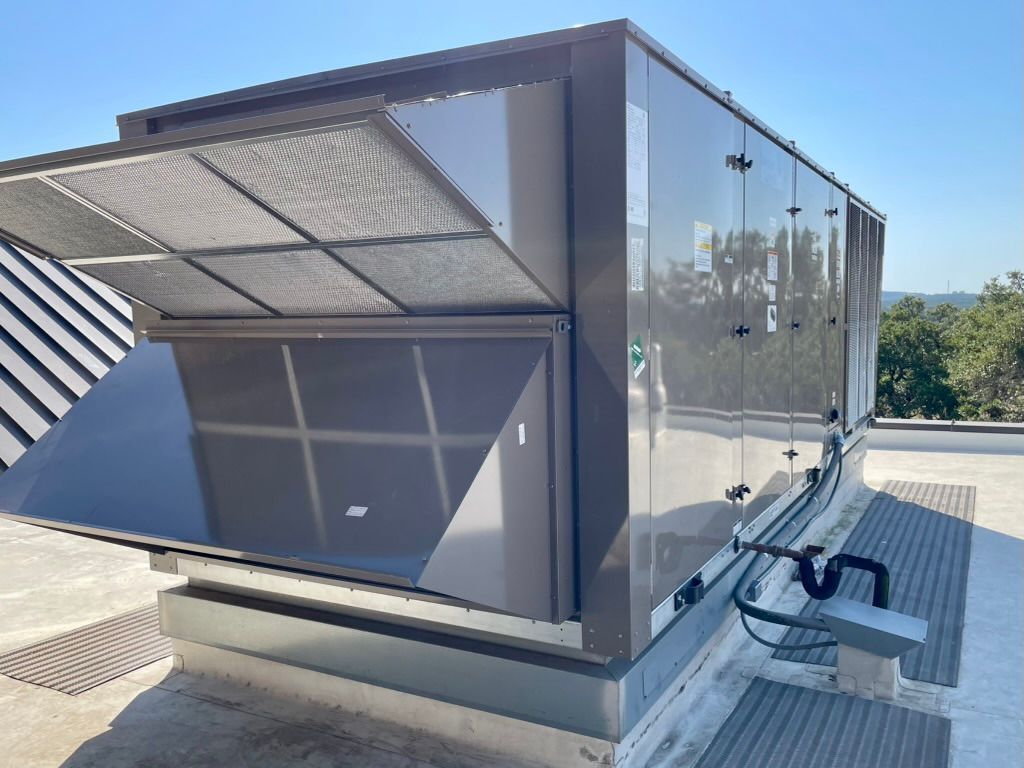
A commercial HVAC replacement is not simply a unit swap. The load calculation step is where most of the real decision-making happens: a system oversized for the space short-cycles and wears components faster than a correctly sized one, while an undersized system runs continuously and never reaches setpoint. Buildings in the Georgetown and Cedar Park commercial corridors often carry equipment that was specified for a previous tenant with lower occupancy density or less heat-generating equipment, which means the replacement is also a correction of the original specification.
After installation, the first observable difference is that the system reaches setpoint consistently and holds it without the compressor cycling on and off in short bursts. Ductwork that was leaking or improperly connected to the old unit is also evaluated during the process, so air delivery to the occupied portions of the building improves alongside the mechanical output.
Efficiency rating is a separate decision from equipment size, and Extreme Texas Air presents the options at the quote stage rather than defaulting to the lowest upfront cost. The operating hours of a commercial space affect how quickly a higher-efficiency unit offsets its installation cost, and that math varies by building type.
Answers About How the Replacement Work Is Done
Commercial HVAC replacement involves several sequenced steps, and the specifics depend on the building's current configuration. The questions below cover what that process looks like from assessment through startup.
What does the load assessment involve before equipment is selected?
The technician measures the conditioned square footage, checks insulation, evaluates occupancy and equipment heat loads, and reviews ductwork capacity to determine what size unit the building actually requires now rather than what the original installer specified.
How is the old system removed without damaging ductwork or electrical connections?
The crew disconnects refrigerant lines according to EPA Section 608 recovery requirements, removes electrical connections at the disconnect, and detaches duct connections carefully so existing plenum and trunk lines can be reused where they are in acceptable condition.
When is ductwork replaced as part of a commercial HVAC replacement?
Ductwork is replaced when inspection reveals significant leakage, crushed sections, or connections that were never properly sealed to the original unit—conditions common in commercial buildings that have been re-tenanted multiple times.
Why does short-cycling indicate a sizing problem rather than a mechanical failure?
A unit that runs briefly and shuts off before completing a full cycle is removing humidity poorly and wearing its compressor faster than designed, which points to oversizing rather than a component fault.
What does performance verification cover before the job is closed out?
The technician confirms supply air temperature differential, checks static pressure at the air handler, verifies thermostat staging, and confirms that all zones reach setpoint within a normal operating window.
Extreme Texas Air also performs commercial HVAC replacement in Kyle, Buda, San Marcos, Dripping Springs, and Lockhart. To start with a load assessment and written quote for your building, call (512) 256-5499 and describe the current system and how your space is configured.